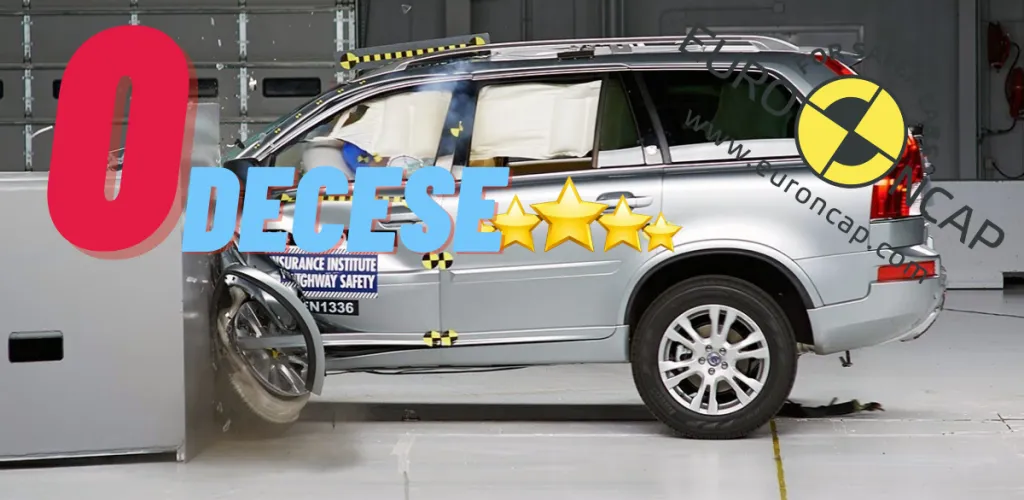
- The XC90 is the only SUV worldwide with zero fatalities in 20 years.
- It has consistently earned five-star safety ratings in all tests.
- Its safety comes from substantial mass, robust structure, and many safety systems.
- Volvo’s safety heritage and DNA underpin the XC90’s design.
The Volvo XC90 stands out for its exceptional safety performance, being the only model worldwide to record zero fatalities in the 20 years since its launch. This extraordinary achievement positions the Swedish SUV as the absolute leader in international safety rankings.
This remarkable achievement positions the Swedish SUV as the absolute leader in international safety rankings.
Exceptional safety test performance
The vehicle has consistently earned five stars in every testing session it has undergone, strengthening its position as a leader in vehicle safety. This consistency in performance demonstrates not only the quality of the initial design but also the ongoing evolution of the safety technologies implemented.
Key factors of superior safety
According to experts, the vehicle’s substantial mass and robust structure are the fundamental elements that make it exceptionally resistant in a collision. This combination provides a significant advantage in impacts with similarly sized or even larger vehicles.
The car is equipped with numerous driver assistance systems, multiple strategic airbags, and other active and passive safety systems that work in synergy to protect occupants.
Volvo’s safety heritage
The Volvo brand has built its reputation on two fundamental principles: quality and safety, both vital in car construction. This philosophy has become the company’s DNA and is reflected in every model produced.
According to official information, Volvo Car Corporation AB was founded by Assar Gabrielsson and Gustaf Larson on April 14, 1927, when the first car, nicknamed “Jakob”, left the factory gates in Gothenburg, Sweden.

Symbolism and brand evolution
The Volvo symbol represents an ancient sign for iron, used to symbolize the strength of iron used in car construction. Sweden being renowned for the quality of its iron, this symbol perfectly reflects the brand’s values of durability and resilience.
In 2010, the Chinese Geely group acquired Volvo for $1.5 billion from Ford, marking a new phase in the brand’s evolution. In 2021, Volvo delivered 1,006 cars in Romania, up 37% from 2020, with 94% of the vehicles sold being electric.
History and evolution of the XC90
Statistics show that between 1927 and 2007, Volvo produced 14,937,411 cars, true symbols of safety and innovation. The XC90 model continues this glorious tradition, with the first XC90 SUV appearing in 2002 and immediately becoming the safest car in the world.
Thatcham Research - Scientific Validation
Thatcham Research, a vehicle safety technology research company, conducted a comprehensive study over 13 years (2004-2017) that confirms the XC90’s exceptional status. The vehicle, rated five stars by Euro NCAP, features unique characteristics that make it the safest car internationally.

Distinctive technical advantages
Mass and structure
Both the first and second generations of the XC90 benefit from a relatively heavy mass, which provides a significant advantage in a collision. This feature, combined with a solid structure, ensures superior protection in various impact scenarios.
Advanced safety technologies
The second-generation model, produced from 2014, introduces revolutionary autonomous technologies:
- Autonomous Emergency Braking (AEB) - the system detects obstacles and automatically applies the brakes
- Lane-keeping sensors - prevent unintentional lane departure
- Active collision avoidance systems - the vehicle can automatically take preventive measures
These technologies not only protect occupants in the event of an accident but actively contribute to preventing dangerous situations.
Expert Perspective
Matthew Avery, director of the Thatcham research team, explains: “All too often, with new cars you don’t see fatalities simply because it takes time for a large number of vehicles to be bought and on the roads. But here we are talking about a car produced for the first time 14 years ago, with a history, and the numbers stand out.”
The XC90’s resilience isn’t only in how it handles the road, but also in passive systems like seat belts, airbags, and the fundamental structure. This combination of active and passive technologies creates a complete protection ecosystem.
Conclusion
The Volvo XC90 remains a benchmark in the automotive industry, showing that safety is not a compromise but an absolute priority. With zero fatalities recorded in over two decades, this SUV sets the standard for the entire industry and reinforces Volvo’s commitment to protecting human life.