- Short trips prevent full recharge; 15–20 minutes needed
- Forgotten accessories discharge batteries; headlights, dashcams, chargers; 0.5A for 10h drains 11%
- Regular maintenance prevents dirt and corrosion; clean terminals and apply grease
- Extended parking causes self-discharge; 1-3% weekly, starting issues after 3–4 weeks
Car batteries are among the most important components of a vehicle, yet they are often the most neglected. Many drivers treat the battery as a reliable part that requires little attention, but in reality, it deserves constant care to function optimally and enjoy a long life.
Whenever the car fails to start in the morning, frustration runs high. In most cases, the issue comes from a discharged battery—a situation that can be avoided with a few simple precautionary steps. Let’s examine the most common mistakes that lead to premature car battery deterioration.
Short trips affect the charging cycle
One of the most common mistakes is using the car only for very short trips. The battery needs 15-20 minutes of engine running to fully recover the energy consumed during startup.
When you use the car only for trips of 3-5 minutes (to the store, ATM, or other nearby destinations), the alternator doesn’t have enough time to fully recharge the battery. This practice leads to gradual discharge and a reduction in battery capacity over the long term.
Solution: For short distances, use alternative means of transport - a bicycle, walking, or public transit. Not only will you protect the battery, but you’ll save fuel and get moving.
Forgotten accessories left on — main cause of battery discharge
Statistics show that over 90% of cases of complete battery discharge are due to consumers leaving accessories plugged in overnight. The most common “culprits” are:
- Headlights or position lights
- Dashcams connected to the 12V outlet
- Phone chargers
- Portable GPS devices
- Active USB ports
- Aftermarket alarm systems
These devices seem to consume little current, but over several hours they can completely discharge a battery. Even a draw of only 0.5 A over 10 hours can discharge a 45 Ah battery by about 11%.
Solution: Develop the habit of checking all accessories before leaving the car. Disconnect devices that are not needed and ensure the headlights are off.
Lack of maintenance - dirt and corrosion
An unmaintained battery is prone to various technical problems. Dirt, dust and corrosion on battery terminals can create a conductive “bridge” that enables current leakage.
When dirt on top of the battery is wet (from rain, moisture or condensation), it becomes conductive and allows slow battery discharge. Also, corrosion on the terminals can cause:
- Increased contact resistance
- Voltage losses
- Inadequate charging
- Starting problems
Solution: Check the battery condition monthly and clean it with a baking soda and water solution. Apply terminal grease to prevent corrosion.

Extended parking without protection measures
Even if all consumers are turned off, a car battery loses voltage through natural self-discharge. This loss varies between 1-3% per week, depending on:
- Ambient temperature
- Battery age
- Battery quality
- Residual draws of electronic systems
After 3-4 weeks of non-use, a battery can drop below the threshold necessary for starting the engine (10.5-11V for 12V systems).
Solution: For long periods of non-use, use a smart charger with a maintenance function. These devices monitor voltage and apply a slow charge only when necessary.
Ignoring early warning signs
The car battery signals its approaching end with various symptoms that appear weeks or months before failure:
Visual symptoms:
- Headlights flicker at idle
- Brightness drops at low idle
- Dash indicators behave erratically
Auditory symptoms:
- The starter sounds sluggish or hesitant
- The engine cranks harder, especially in the morning
- The audio system flickers at startup
Performance symptoms:
- Starter rotation speed decreases
- Cranking time increases
- Electronic systems reset at startup
Solution: At the appearance of these symptoms, have the battery tested at an auto service. A battery with capacity below 80% of the nominal value should be replaced proactively.
Preventive measures for a healthy battery
To maximize the lifespan of your car battery:
- Test capacity annually - Most car batteries have a lifespan of 3-5 years
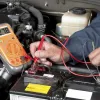
- Check voltage regularly - A healthy battery should hold 12.6V when the engine is off
- Keep terminals clean - Clean corrosion monthly and apply protection
- Avoid deep discharges - These dramatically reduce lifespan
- Use a smart charger - For long periods of non-use
By following these simple tips, you will avoid unpleasant surprises and save money in the long run. A properly cared-for battery can function trouble-free for 4-5 years, while a neglected battery may fail after only 2-3 years.