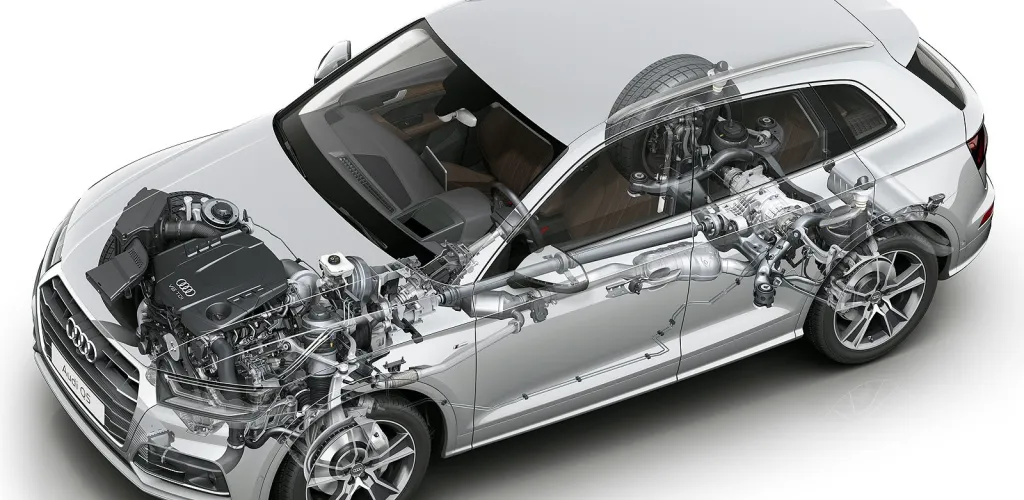
- Quattro distributes power to all four wheels for higher grip.
- Torsen differential provides 50/50 baseline and up to 75% to gripier axle.
- Multi-plate clutch (1998+) sends power rearward automatically when grip drops.
- Self-locking center differential (post-2005 RS4): 40/60 front/rear, redistributes up to 60% front or 80% rear.
The Audi quattro all-wheel drive system is regarded as one of the most advanced technologies in the automotive industry, featured in about a third of all vehicles produced by the German marque. This technology revolutionized the concept of all-wheel drive, delivering a balance of performance, safety and efficiency.
Over the decades, quattro has evolved from a simple 50/50 power distribution system to sophisticated technologies with active differentials and torque vectoring. Each generation has brought significant improvements in grip, stability, and driving pleasure.
How the quattro system works
The basic concept of the quattro system is distributing power to all four wheels, thereby delivering a higher lateral grip compared with vehicles with single-drive. This approach allows more efficient use of engine power and improved grip in various road conditions.
All-wheel drive system quattro can be permanent or disconnectable, depending on the model and generation of the vehicle. The first system was extremely simple – power was distributed equally, 50% to each axle, with no possibility of dynamic adjustment.
Technological evolution of the quattro system
Torsen differential - the first revolution
- Standard distribution: 50% front, 50% rear
- Redistribution capacity: up to 75% to the axle with better grip
- Automatic locking under maximum load
- Automatic unlocking when the driver lifts off the accelerator
- Manual locking option via electro-pneumatic system
This type of differential is ideal for vehicles with longitudinal engines, offering quick and efficient response to loss of grip.
Multi-plate clutch - the solution for transverse engines
In 1998, for transverse-engine and more compact models, Audi engineers developed the electronically and hydraulically controlled multi-plate clutch system. This technology brought the following advantages:
- The clutch is mounted at the end of the driveshaft, before the rear differential
- Under normal conditions, power is transmitted only to the front axle
- Sensors detect loss of grip and automatically engage the rear axle
- Rapid response to changing road conditions

Self-locking center differential - top performance
After 2005, Audi raised the bar with the introduction of the self-locking center differential, debuting on the RS4 from the second generation. This technology brought the following specifications:
Power distribution:
- Normal conditions: 40% front, 60% rear
- Front redistribution capacity: up to 60%
- Rear redistribution capacity: up to 80%
- Integrated into the transfer case (newer models)
This system offers a sportier behavior, being favored for performance-oriented vehicles.
Special configurations - the R8 example
The supercar R8 uses a unique configuration tailored to a mid-engine and transmission placed behind it. The driveshaft runs past the engine to reach the front differential, in a very tight space.
R8 system characteristics:
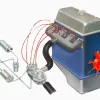
- Viscous coupling for controlling power distribution
- Standard distribution: 85% rear, 15% front
- Behavior similar to rear-wheel drive under normal conditions
- Automatic intervention when needed for maximum grip
Sport differential - top-tier technology
Since 2008, debuting on the S4, the sport differential brings the following benefits:
Technical features:
- Torque split between rear wheels
- Reaction time: a few hundredths of a second
- Fully electronic control
- Precise calculations to optimize grip
Driving advantages:
- Elimination of understeer tendency in fast corners
- Power transmitted to the wheel on the outside of the turn
- Improved stability during acceleration in bends
- The feel of driving on rails

Crown-gear differential - the latest generation
The latest evolution of the quattro system uses a crown-gear differential, available only for quattro all-wheel-drive vehicles with longitudinal engines.
Superior performance:
- Most efficient power distribution to date
- Up to 85% of power can be transmitted to the rear axle
- Up to 70% to the front axle when the rear grip is lost
- Equipped with torque vectoring on RS5, A7 Sportback and A6 models
Torque vectoring - individual wheel control
The torque vectoring system represents the pinnacle of quattro technology:
- It acts on each wheel individually
- Imperceptible braking to recover traction
- Automatic optimization of power distribution
- Improved stability and agility
Reliability of the quattro system
Quattro drivetrain systems are known for their high reliability, provided service intervals are respected. Primary components requiring attention include:
Maintenance points:
- Differential oil changes at recommended intervals
- Check the condition of the multi-disc clutch (where applicable)
- Inspect grip sensors and ABS
- Inspect driveshafts and joints
Common problems:
- Multi-disc clutch wear at high mileage
- Wheel speed sensor failures
- Oil leaks from differentials on older vehicles
- Issues with electronic actuators on advanced systems
Impact on fuel consumption
The quattro system influences fuel consumption to a reasonable extent:
Factors contributing to higher consumption:
- Additional weight of components (about 50-70 kg)
- Internal differential friction
- Power transfer losses to all four wheels
- More frequent activation in challenging conditions
Increase in consumption:
- Compact models: 0.3-0.5 L/100 km
- Larger models: 0.5-0.8 L/100 km
- Varies with driving style and road conditions
From practical experience, the safety and performance benefits far outweigh the minor drawback of slightly higher fuel consumption.
Recommendations for owners
To keep the quattro system operating at optimum parameters:
- Preventive maintenance: Follow service intervals for all fluids
- Identical tires: Use the same tire type and wear across all four wheels
- Preventive driving: Avoid extreme maneuvers without proper warm-up
- Periodic diagnostics: Check sensor operation with specialized testing
- Authorized service: Rely on specialists for complex repairs