- A blown fuse cannot itself drain the battery; problem lies elsewhere.
- Parasitic drain sources include radio left on, interior lights, alarms, faulty modules, damaged wiring.
- A blown fuse at the alternator or damaged fusible link prevents charging.
- Normal drainage thresholds: newer cars 50–85 mA; older cars up to 50 mA.
One common question among drivers is whether a blown fuse can be responsible for draining the car battery. The short answer is that the fuse itself cannot draw electrical current. The real problem is usually found in damaged wiring or in the component the fuse protects. In this article, we will explore in detail the causes of parasitic current draw and how you can identify the issue.
If the battery isn’t very old but continues to discharge, the problem may also stem from the alternator. A fuse at the alternator that is blown or a damaged fusible link will prevent proper charging. In the long term, this will lead to complete discharge and the engine may fail to start.
Causes of parasitic current drain
When the car is off, the battery should not discharge significantly overnight. However, several components can cause a parasitic drain:
- Radio left on continuously
- Interior lights left on
- Headlights not fully switched off
- Security systems or alarms that are faulty
- Electronic modules that do not enter sleep mode
- Damaged wiring that creates short circuits
If the battery isn’t very old but discharges consistently, the problem may also come from the alternator. A fuse at the alternator that is blown or the fusible link that is damaged will prevent charging the battery properly. In the long term, this will lead to complete discharge and the engine won’t start.
Relationship between blown fuses and parasitic drain
A blown fuse itself creates an open circuit, cutting power to the respective component. Technically, it cannot draw current because the circuit is open. The problem appears before or after the fuse:
Short circuits before the fuse
A short in the wiring can cause the fuse to trip repeatedly. If there is an intermittent contact or a weak connection, this can create a parasitic drain that discharges the battery even after the fuse has blown.
Defective components
Sometimes the component protected by the fuse (a relay, an electronic module, or an electric motor) can have an internal fault that creates a permanent current draw. When the fuse blows, the problem temporarily disappears, but the underlying cause remains.
Normal and abnormal parasitic drain values
It is important to understand what constitutes normal versus problematic drain:
For newer cars:
- Normal drain is between 50 and 85 mA
- This drain includes security systems, memory of computers, and other modules that remain active
For older cars:
- A drain of up to 50 mA is considered normal
- Older cars have fewer active electronic systems in idle
Problematic values:

- Any drain over 100 mA (0.10 A) will discharge the battery relatively quickly
- A drain of 0.50 A or more can discharge a battery in a few hours
If your measurements exceed normal values, there is certainly an electrical problem that needs attention.
How to identify parasitic drain
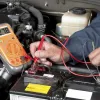
To locate the source of parasitic drain, you need a digital multimeter:
- Prepare the multimeter: Set it to current measurement (amperes), starting with the 10 A scale
- Disconnect the battery: Remove the negative (-) battery cable
- Connect the multimeter: Place the multimeter in series between the battery terminal and the disconnected cable
- Wait for stabilization: Let the car rest for 10–15 minutes so all modules enter sleep mode
- Read the value: The displayed value represents the total parasitic drain
Testing fuses
After you’ve measured the total drain, you can start removing fuses one by one:
- Remove a fuse and observe if the drain decreases on the multimeter
- If you find a fuse that, when removed, significantly reduces the drain, you have identified the problematic circuit
- Check all components protected by that fuse
Alternator issues
The alternator plays a crucial role in keeping the battery charged. A fuse at the alternator, if blown or the fusible link is damaged, will prevent charging the battery.
Symptoms of a faulty alternator:
- The battery drains even after a long drive
- Dashboard lights flicker or are dim
- The battery indicator on the dash is lit
- Unusual noises from the alternator area
With a completely faulty alternator, the battery can power the car for only 30 minutes to two hours, depending on active loads. Starting the engine uses the most from the battery, so if you suspect an alternator problem, avoid turning off the engine until you reach a mechanic.
Faulty relays and parasitic drain
Relays are electrical switches that control components requiring high current. A relay stuck in the closed position can keep the component powered continuously:
ECM relay (engine computer): If the relay that powers the engine computer remains closed, the car’s computer will stay on even when the car is off. This creates a significant drain that will discharge the battery in a few hours or overnight.
Cooling fan relay: A stuck relay can keep the cooling fan running, leading to rapid battery drain.
Fuel pump relay: Similarly, a faulty relay can keep the pump active, consuming current unnecessarily.
Battery drain during idle
Even when the car is not in use, the battery naturally discharges through self-discharge. This internal chemical process is normal and inevitable:
- Lead-acid batteries self-discharge by about 5% per month at normal temperatures
- At higher temperatures (above 30°C), the self-discharge rate can reach 10–15% per month
- AGM and gel batteries have a lower self-discharge rate
If the car sits idle for more than two weeks, it is advisable to disconnect the battery or use a maintenance charger (trickle charger).
Recharging a completely discharged battery
The car’s alternator is not designed to fully recharge a completely discharged battery. Attempting to do so can lead to:
- Overloading the alternator
- Incomplete charging of the battery
- Reduced lifespan of both components
Correct solution: Use a smart battery charger that can:
- Detect the battery state
- Apply the appropriate charging current
- Prevent overcharging
- Recondition the battery if necessary
A completely discharged battery requires 8–24 hours for a full recharge, depending on its capacity and the charger.
Replacing fuses – proper procedure
When replacing a fuse, it is important to follow the correct procedure:
Do you need to reconnect the battery? Yes, to test if the new fuse works correctly, the battery must be connected. Without power, you cannot verify whether the circuit operates.
Steps for replacing the fuse:
- Identify the blown fuse using the diagram on the fuse box cover
- Check the correct amperage on the old fuse
- Remove the fuse with tweezers or a special extractor
- Visually inspect whether the inner filament is intact or broken
- Replace with a fuse of the same amperage (NEVER higher!)
- Test the component’s operation
Important: If the new fuse blows immediately, DO NOT replace it with a higher amperage. This indicates a serious circuit problem requiring professional diagnostics.
Conclusion
A blown fuse does not drain the car’s battery by itself, but it can be a symptom of more serious issues in the electrical system. Parasitic drain usually has causes such as defective components, stuck relays, electronic modules that do not enter sleep mode, or alternator problems. Correctly identifying the source requires methodical testing with a multimeter and knowledge of normal drain values. If you notice the battery regularly discharging overnight, it is essential to diagnose the problem quickly to avoid damaging the battery and other electrical components. If you do not have experience working with automotive electrical systems, the safest course is to consult a qualified auto electrician.