- Romanian license rules: automatic-license holders cannot drive manual cars.
- Switching to manuals requires a 6-hour course and exam.
- Clutch mistakes: keep foot off clutch; use it only when shifting.
- Shifter resistance signals issues; fully release clutch and retry to avoid damage.
Introductory note The Romanian automotive landscape is changing rapidly, and cars with automatic transmissions are becoming more prevalent on our streets. Yet, the manual transmission remains a valued option for many experienced drivers, offering greater control and a more engaging driving experience. For those who choose to drive a manual, knowing the correct operating techniques is essential to keep the vehicle in optimal condition.
In addition, understanding proper clutch use, gear changes, and routine maintenance can help extend the life of the gearbox and improve overall efficiency.
Important legal considerations for beginner drivers
In recent years, Romania’s road legislation has adapted to new trends in the auto industry. If a few years ago driver education could be completed exclusively on manual-transmission cars, today prospective drivers have the option to learn on automatic vehicles.
There is, however, a crucial difference: those who obtain a license for automatic transmission can drive only this type of vehicle. If you are stopped while driving a manual car with an automatic license, the consequences are severe—you may face a criminal charge for driving a vehicle without the proper license.
There is, however, a solution for those who wish to switch from automatic to manual: a 6-hour training course, followed by passing a driving exam on a manual car. After passing the exam, you will have the right to drive any type of vehicle.
Common mistakes that harm the gearbox
Keeping your foot on the clutch while driving
This is probably the most common mistake made by manual-gear drivers. There are two typical scenarios:
- On long trips: many drivers rest their left foot on the clutch pedal instead of keeping it in the space provided to the left of the pedal
- In traffic: some drivers press the clutch fully and keep it pressed for tens of seconds, anticipating a gear change
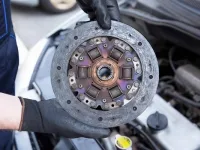
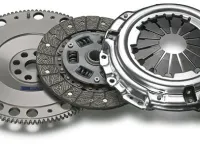
These habits cause premature wear of the clutch. Even light pressure creates friction between the clutch disc and the flywheel, which over time leads to clutch slip and improper system operation. The clutch disc is a wear part that can cost hundreds or even thousands of euros to replace, depending on the model.
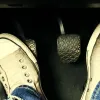
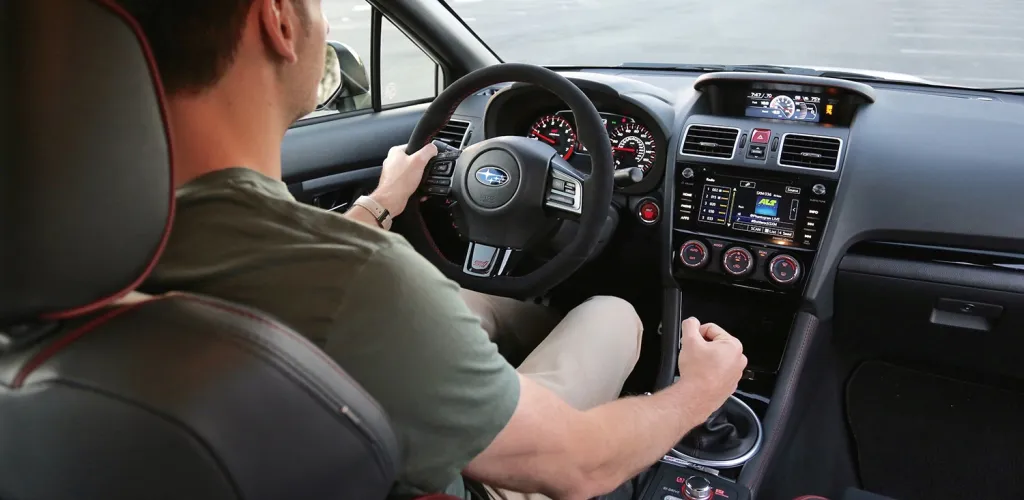
The Correct Solution: Keep your left foot relaxed in the space to the left of the clutch pedal. Use the pedal only when actually changing gears.
Forcing the shifter into gears
In older vehicles or those with certain faults, the shifter may resist entering or enter gears hard, especially first. Causes can include:
- Worn clutch that no longer engages properly
- Incomplete release of the clutch pedal
- Pressure plate not fully releasing from the flywheel
- Degraded or low transmission oil
- Worn synchronizers
Forcing the shifter can damage gear teeth, synchronizers, and other components of the gearbox, leading to costly repairs.
The Correct Solution: If a gear doesn’t go in easily, fully release the clutch and press the pedal again. If the problem persists, check the transmission oil level and quality, and the condition of the clutch.
Shifting into reverse while the car is still moving
This is one of the most destructive mistakes you can make. Many parking maneuvers or turns require multiple changes between forward and reverse. If you shift into reverse while the car is still moving forward, even at a very low speed, you risk:
- Gear teeth damage
- Synchronizer damage
- Loud gearbox noises
- In the worst cases, complete gearbox destruction
Reverse is the most vulnerable in this regard because it typically has no synchronizer or a weaker one than forward gears.
The Correct Solution: Always wait for the car to come to a complete stop before shifting into reverse. Press the clutch all the way to the floor—unlike other gears, reverse requires full pedal depression to avoid noises and premature wear.
Starting on a slope without the handbrake
Starting on an incline remains challenging even for experienced drivers. Many drivers compensate by revving the engine, which prematurely wears the clutch discs and increases fuel consumption.
Correct technique with the handbrake:
- Stop completely and pull the handbrake
- Shift into first gear
- Slowly release the clutch while slightly accelerating
- When you feel the clutch engage (the car begins to tremble slightly), release the handbrake
- Continue releasing the clutch and increasing speed progressively
This technique significantly reduces clutch disc wear and eliminates the risk of rolling backward or stalling the engine.
Forcing the gearbox when the engine is cold
Few drivers have the patience to wait 1–2 minutes for the engine to warm up before driving away. This matters not only for the engine but also for the gearbox. When cold, especially in winter:
- Transmission oil is more viscous and does not lubricate components optimally
- Gear changes can be slow or grind
- Synchronizers work harder
- Wear increases
Recommendations for cold-start driving:
- Wait at least 30–60 seconds before departing
- In the first kilometers, drive smoothly, avoiding high revs
- Do not force gears if they do not enter easily
- Wait for the temperature gauge to reach halfway for optimal performance
These measures prolong engine life, improve vehicle performance, and reduce fuel consumption.
Other useful tips for maintaining the manual gearbox
Correct gear changing
For optimal gear changing:
- Fully press the clutch pedal
- Pause briefly in neutral between gears
- Release the clutch progressively, especially in the lower gears
- In normal acceleration, shift gears around 2,000–3,000 RPM for diesel engines and 2,500–3,500 RPM for petrol engines
Preventive maintenance
- Check and change transmission oil according to the manufacturer’s recommendations (usually around 60,000–100,000 km)
- Watch for unusual noises from the gearbox area
- If you feel vibrations in the gear lever or difficulties changing gears, have the system checked promptly
- Periodically inspect the clutch fluid level
Advantages of the manual transmission
Despite the rising popularity of automatics, manual transmission offers:
- Greater control over the vehicle
- Lower maintenance costs
- Potentially lower fuel consumption (with efficient driving)
- A more engaging and enjoyable driving experience
- The ability to use engine braking
Conclusion
Driving a manual transmission car correctly is not only about the pleasure of driving but also about prolonging the life of components and ensuring a comfortable and safe ride. Avoiding the common mistakes presented in this article will save you money in the long run and keep the vehicle in optimal operating condition.
Manual transmission remains a valuable option for those who appreciate direct control over the car and active involvement in the driving process. With the correct techniques and attention to detail, you can enjoy the benefits of this type of transmission for many years.