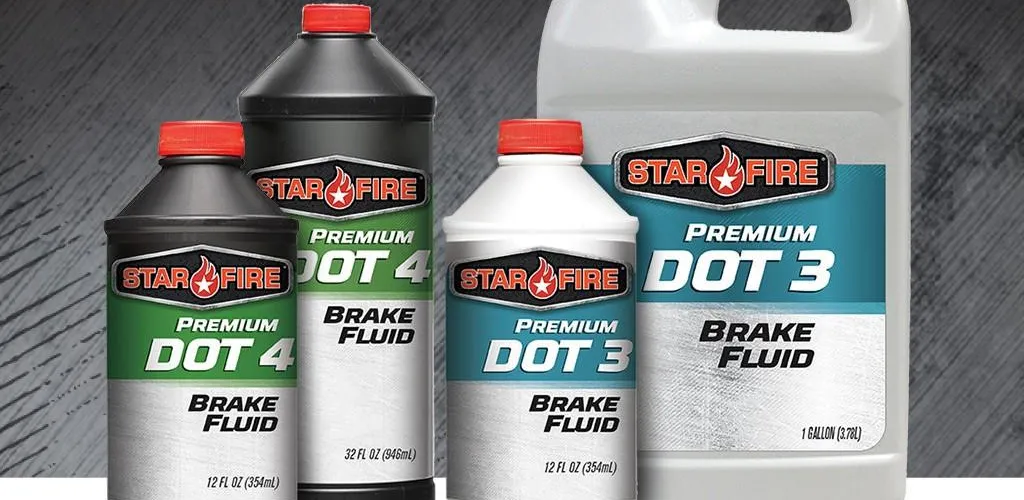
- DOT4 has higher dry and wet boiling points than DOT3 (230°C/155°C vs 205°C/140°C).
- DOT3 absorbs moisture more readily, lowering its boiling points over time.
- DOT3 is common in stock vehicles; DOT4 is safer for frequent braking and extreme use.
- There are four main brake fluid types; DOT standards must be met.
Choosing the right brake fluid type can make the difference between an efficient braking system and one that fails at critical moments. While both DOT3 and DOT4 meet the minimum safety standards, their technical differences can influence your vehicle’s performance in various driving conditions.
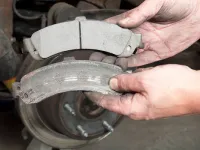
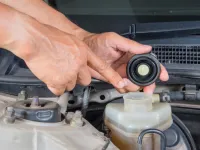
The braking system of vehicles contains [Brake fluid] to keep its moving components functioning. Like any mechanical system, the braking system requires a specialized fluid because its moving parts tend to heat up as they are used.
If there is no brake fluid or if its level is low, the braking system will not perform well, potentially leading to dangerous situations on the road.
Classification and standards of brake fluids
There are four main types of brake fluid, distinguished by their DOT designation. This designation represents the specific chemical blend of the brake fluid and the performance standards it meets.
As long as the brake fluid adheres to the minimum standards of the American Department of Transportation, it is acceptable to use in a car’s braking system. Of the four types of brake fluid, the most popular and commonly used in Romania are DOT3 and DOT4.
Boiling Points: The Decisive Factor
To understand the difference between DOT3 and DOT4, we need to pay attention to the two different boiling points, which represent the most important technical characteristic.
Dry Boiling Point
- DOT3: 205°C
- DOT4: 230°C
Wet Boiling Point
- DOT3: 140°C
- DOT4: 155°C
As you can see, DOT3 brake fluid has lower boiling points, both in dry and wet conditions, which can affect performance under extreme conditions.
DOT3 Brake Fluid Characteristics
Chemical composition and use
DOT3 is considered the most popular brake fluid and is used on most stock vehicles. Its glycol-based chemical composition can handle a fair amount of heat, but not as much as DOT4 brake fluid.
Moisture absorption
The reason the boiling point is lower for DOT3 than for DOT4 is that DOT3 brake fluid absorbs water from the atmosphere more readily. This leads to a reduction in both the brake fluid’s performance and its boiling point over time.
Practical applicability
For normal vehicles used in urban traffic and on regular roads, this is not a major issue, since you don’t brake as aggressively as police cars or race cars. In these conditions, a DOT3 brake fluid fits your needs perfectly.

DOT4 Brake Fluid Characteristics
Higher temperature performance
DOT4 brake fluid is considered safer and can withstand higher temperatures than DOT3 brake fluid. Because it resists more heat, it becomes safer when the braking system components have been used frequently in a short period of time.
Use in extreme applications
For this reason, more aggressive vehicles, such as race cars, police cars or vehicles that tow heavy trailers, are known to use DOT4 brake fluid.
Thermal behavior
DOT4 brake fluid operates more quickly under a dry boiling point than under a wet boiling point, due to its more advanced chemical composition. DOT3 is capable of performing relatively uniformly across both dry and wet boiling points.
Compatibility and mixing
Can they be mixed?
In principle, DOT3 and DOT4 are compatible and can be mixed, but this is not recommended. Mixing will produce a fluid with intermediate properties, effectively reducing the benefits of DOT4.
Manufacturer recommendations
Always check the owner’s manual to see which type of brake fluid the manufacturer recommends. Using the wrong type can affect the vehicle warranty.
When to choose DOT3 versus DOT4
Choose DOT3 if:
- You primarily drive in the city or on normal roads
- Your vehicle is approved specifically for DOT3
- Budget is an important consideration
- You do not practice sporty driving
Choose DOT4 if:
- You frequently drive in extreme conditions (mountainous terrain, demanding traction)
- You practice sporty driving or participate in racing
- Your vehicle is equipped with high-performance ABS/ESP systems
- You want extra safety
Maintenance and replacement
Change frequency
Regardless of the type chosen, brake fluid should be replaced at regular intervals:
- DOT3: every 2 years or 40,000 km
- DOT4: every 2-3 years or 60,000 km
Signs that the fluid needs to be changed
- The color has darkened (from light yellow to brown)
- The consistency has become viscous
- The boiling point has fallen below minimum values
- Sediments in the reservoir
Conclusion
You might wonder why DOT3 brake fluid hasn’t been completely replaced by DOT4, given that the latter is significantly more performant and the price difference is small.
The answer lies in the fact that more vehicles are homologated for DOT3 than for DOT4. Additionally, for most drivers who drive normally, DOT3 provides sufficient performance at a lower cost.
These trends may change in the near future as stricter regulations and advanced technologies shape braking systems, making DOT4 the standard for all vehicles.
Source: carfromjapan.com, wikihow.com