- Handbrake and emergency brake are the same system.
- It uses a mechanical cable, separate from hydraulic braking.
- Primary roles: parking brake and emergency stop if main brakes fail.
- EPB is common on automatics; ADAS can auto-brake when necessary.
Many drivers wonder if there is any difference between the handbrake and the emergency brake. The answer is simple: they are exactly the same system, only with different names used in different contexts. This secondary braking mechanism plays a crucial role in vehicle safety, designed to operate independently of the main braking system.
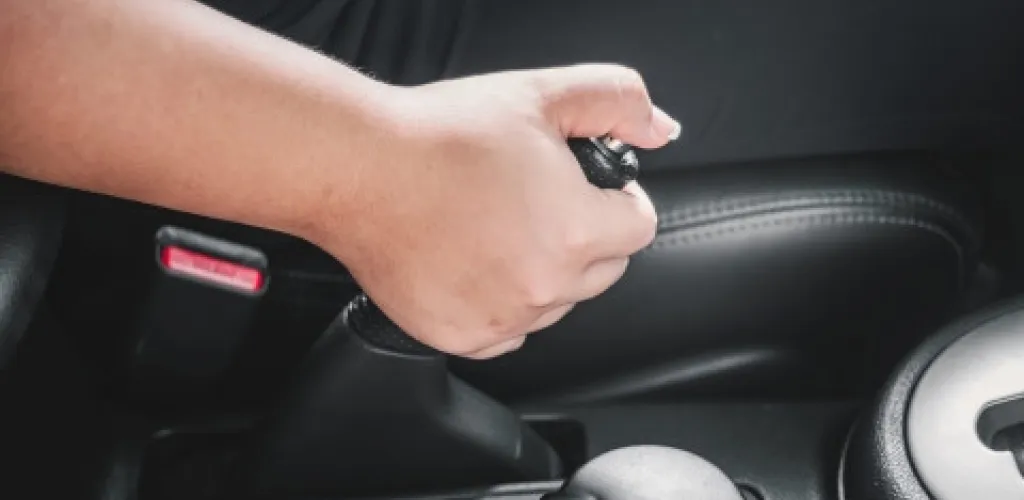
The handbrake represents a completely separate braking system from the main one of the car, which is activated by pressing the brake pedal. By engaging the handbrake you activate an independent cable-based system, different from the main braking system, which operates via brake fluid.
How the handbrake works
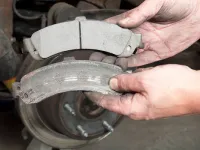
The handbrake stops the vehicle using rear brake pads, but the actuation mechanism is fundamentally different from the main system. While the regular brake uses hydraulic pressure transmitted by brake fluid, the handbrake operates purely mechanically.
From the handbrake lever originates a main cable that splits into two separate cables, each mechanically actuating a rear brake pad. This direct mechanical system eliminates dependency on the hydraulic circuit and provides a safety alternative.

Main roles of the handbrake
Parking brake
The most common role of the handbrake is as a parking brake. It is engaged when you park the car and leave it in gear or neutral, locking the rear wheels and preventing uncontrolled vehicle movement. This is standard practice whether parking on flat ground or on a slope.
Emergency brake
The idea of the system is to provide the option of emergency braking in case the main braking system fails. In critical situations, when the brake pedals no longer respond due to a hydraulic fault, the handbrake can be the only option to stop the vehicle.
Modern developments: electric parking brake
For cars with automatic transmission, many newer models come with an electric handbrake or electronic parking brake (EPB). They are equipped with a button that you cannot activate while moving above a certain speed. The purpose of this system is that, when the car is in Park, it automatically immobilizes the rear wheels.
Advanced safety systems
Modern cars equipped with advanced driver-assistance systems (ADAS) can automatically activate the emergency brake in certain situations. For cars with forward-facing sensors, the sensor continuously scans what lies ahead. If it detects a danger the driver cannot avoid, the car will brake automatically.

In rare cases, regardless of speed, the system will apply strong braking, including the emergency brake, to avoid or reduce the severity of impact.
Handbrake maintenance
For optimal operation, the handbrake requires periodic maintenance:
- Cable inspection: Cables can stretch or corrode over time
- Tension adjustment: A brake that is too loose or too tight can cause problems
- Pad inspection: The brake pads should be checked just like those on the main brake
- Lubrication: Pivot points require lubrication for smooth operation
In conclusion, the handbrake and the emergency brake are the same system, designed to provide additional safety and flexibility in using the vehicle. Regardless of the name, this mechanism remains an essential element of road safety.
Photo source: haynes.com