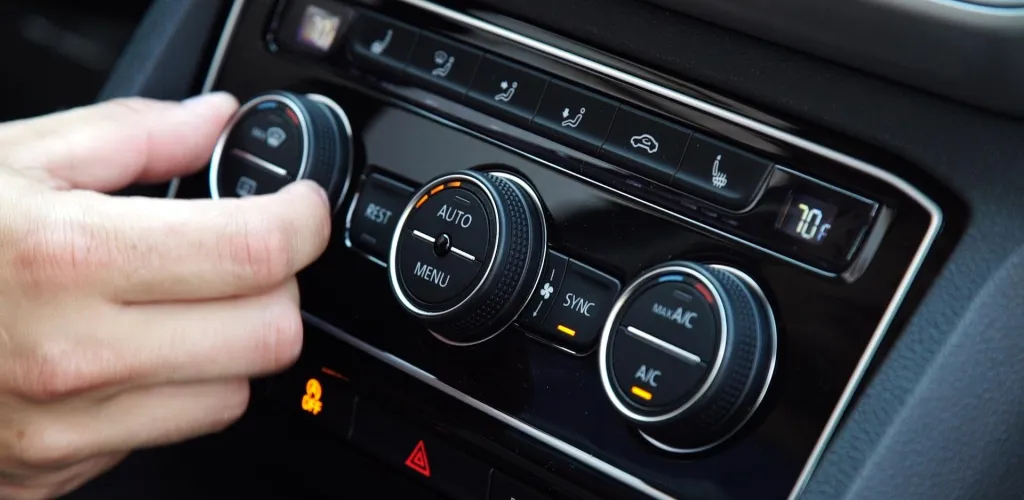
- Climate control maintains cabin temperature and humidity for comfort and safety
- Defog function automatically activates climate control to improve visibility
- Core components include compressor, condenser, evaporator, receiver/drier, expansion valve
- Refrigerant cycle uses compression, condensation, and filtration to transfer heat
Car air conditioning systems have become an essential component of modern vehicles, transforming the driving experience on hot summer days. Beyond the obvious cooling role, this complex system contributes significantly to road safety by maintaining an optimal cabin temperature and reducing excess humidity.
In the context of ongoing climate change and increasingly hot summers, the importance of an efficient climate control system is even more evident. From its first implementations in 1939 by Packard, when only luxury cars benefited from this technology, to today, when it is standard on nearly all new vehicles, the automotive air conditioning system has evolved considerably.
Main functions of the automotive air conditioning system
The primary role of the climate control system is to maintain a comfortable temperature inside the vehicle, but its functions extend well beyond mere cooling.
Temperature and humidity control
The air conditioning system not only cools the cabin air but also removes excess humidity, creating a comfortable environment for the driver and passengers. This aspect is crucial not only for comfort but also for the health of the occupants.

Visibility improvement
In modern models, the climate control system automatically activates when the windshield defog function is selected. By removing humidity from the air, the system prevents condensation on the glass, ensuring optimal visibility — a crucial aspect for road safety.
Essential components of the system
Any automotive air conditioning system, regardless of manufacturer, is built around the same fundamental components, each playing a specific role in the conditioning process.
Main components
Compressor - The heart of the system, responsible for compressing and circulating the refrigerant through the entire circuit. It is driven by the vehicle’s engine via a belt.
Condenser - Mounted in front of the radiator, it converts the high-pressure freon vapors back into a liquid, dissipating the heat to the atmosphere.

Evaporator - Located inside the cabin, where freon evaporates and absorbs heat from the air passing through it.
Receiver/drier/accumulator - Filters and dries the refrigerant, removing impurities and moisture from the system.
Expansion valve or orifice tube - Controls the freon flow to the evaporator and reduces its pressure.
Principle of operation of the system
The operation of the automotive air conditioning system is based on the thermodynamic principles of phase change of a refrigerant, typically freon.
Step-by-step refrigerant cycle
-
Compression - The compressor aspirates freon vapors at low pressure and compresses them, transforming them into high-pressure, high-temperature vapors.
-
Condensation - The hot vapors reach the condenser, where they release heat to the atmosphere and condense into a high-pressure liquid.
-
Filtration - The liquid freon passes through the receiver/drier where impurities and residual moisture are removed.
-
Expansion - As it passes through the expansion valve or orifice tube, the freon’s pressure drops sharply, causing rapid cooling.
-
Evaporation - In the evaporator, freon at low pressure absorbs heat from the cabin air, evaporating back to a gaseous state.
-
Reco mpression - The low-pressure vapors are drawn back into the compressor, completing the cycle.

Refrigerant quantity
Each vehicle has a specified precise amount of freon required for optimal system operation. Typically, this varies between 1-2 liters, and refrigerant recharging should be performed periodically to maintain system efficiency.
Important technical aspects
Refrigerant types
Over time, the auto industry moved from R-12 to R-134a, and more recently to R-1234yf, a more eco-friendly refrigerant with a lower global warming potential.
System maintenance
For optimal performance, the system requires:
- Periodic checking of refrigerant level
- Condenser cleaning
- Replacement of the cabin air filter
- Checking compressor operation
- Disinfecting the system to remove bacteria and odors
Signs of a malfunction
- Insufficient cooling or no cooling
- Unusual odors from the ventilation system
- Abnormal compressor noises
- Excess condensation or refrigerant leaks
- Increased fuel consumption
Impact on fuel consumption and performance
Using air conditioning affects the vehicle’s fuel consumption, especially at low speeds or in urban traffic. However, at higher speeds, running the climate control can be more efficient than driving with open windows due to the increased aerodynamic drag.
The automotive air conditioning system is a complex technology that combines physics principles with advanced engineering to provide comfort and safety. Understanding how it works helps in efficient use and early identification of potential issues.