The car battery is a consumable component. Normally, a car battery should last between 5 and 6 years if used under normal conditions. If you’ve landed on our article, there’s a good chance that the battery in your Subaru Forester has given out. You may have tried to start the car this morning, and the engine won’t turn over. If this is the case, it’s likely the car battery that’s at fault. Your car’s battery is no longer storing energy.
Now, you need to replace the battery, and we thought it would be a good idea to write an article about how to properly disconnect the car battery. The procedure itself is simple, but it’s best to read our article all the way through; you’ll certainly learn a few new things. By the end, you’ll have some new knowledge to apply.
Here are some tips related to changing and disconnecting the battery in an Subaru Forester:
Before getting started, here are some useful tips to perform this operation safely and save time while doing it. Some of these tips may seem obvious, but you can never be too sure that you’re following the procedure correctly.
Ensure the Car Is on a Flat Surface: Before you begin, make sure the car is parked on a level surface, and engage the handbrake or put the car in park or first gear to ensure the vehicle won’t move.
Wear Gloves: The car battery may still have some charge and can discharge a significant amperage. If you’re using a battery charger or providing power to the car, make sure the battery terminals don’t touch each other, and avoid touching any metal parts if you accidentally touch the terminals together. Remove any metal rings or necklaces.
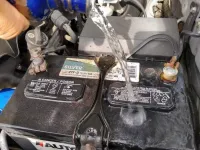
Remove Corrosion: Over time, battery terminals can corrode, and you might notice greenish deposits. These deposits can be both acidic and toxic. Use gloves and a wire brush to clean the terminals before removing the cables.
Prevent Short-Circuit: After disconnecting both battery terminals, be careful not to let them touch each other. This can cause a short-circuit in the electrical system. Some cars have two batteries, so if you’ve only disconnected one and the terminals touch, it can lead to a short circuit that may damage the car’s computer and more. Keep them separated.
Now, let’s get to work. Here’s how to correctly disconnect the battery terminals from an Subaru Forester:
Now, let’s move on to the main topic of this article and the primary reason you’ve visited our page: how to properly disconnect the car battery terminals.
Once you’ve ensured you’ve done everything as described above, you can start removing the battery. Doing this is relatively straightforward if you’re careful. First, you need to remove the plastic covers that protect the metal battery terminals and connectors.
After removing the cover, check if there are signs of corrosion on the terminals. If you find any, put on protective gloves and use a wire brush to clean the terminals before removing the cables.
After cleaning the terminals, you’ll need to remove the negative terminal first. The negative terminal is typically marked with a minus (-) sign. You’ll most likely encounter a bolt to be removed. The bolt size is usually 8mm, 9mm, or 10mm. You’ll need a wrench or socket wrench to do this. If you’re not sure which terminal is negative, it will have a minus (-) symbol on it. After disconnecting the negative terminal, set it aside, away from the car’s chassis.

Don’t disconnect the positive terminal first, and don’t let it touch the car’s chassis to avoid creating a short-circuit. After disconnecting the negative terminal from the battery in the Subaru Forester, it’s time to disconnect the positive terminal, which is marked with a plus (+) sign.
After disconnecting both terminals and ensuring they don’t touch each other, you can remove the battery. In most cases, batteries are secured in place to prevent movement on their mountings. These attachments could be textile straps, screws, or nuts, depending on your vehicle. In any case, they’re usually easy to undo. After undoing all attachments, you can safely remove the battery from the car. Try to remove the battery as level as possible to prevent potential acid spillage, and remember to wear gloves when handling the battery.
After installing the new battery, make sure that you or the person who installed it resets the car’s computer memory regarding the old battery. You need to perform a battery reset using a diagnostic tool (BMS) to inform the vehicle that a new battery has been installed. Why is it important and necessary to do this to extend the life of the new battery?
If you don’t reset the battery, the car will think it still has the old one. The old battery has lost some of its properties over the years, and toward the end of its life, the car struggles to charge it using more power. When you install a new battery, the car overexerts it with aggressive, prolonged charging and higher operating temperatures because it thinks it’s still the old battery. As a result, you might end up replacing the new battery in 1-2 years.
Additionally, if the car is parked for an extended period in the garage, occasionally use a smart charger to maintain the battery in excellent working condition for a longer time.