- Pulse chargers revive dead batteries by desulfating lead plates, more effective than conventional chargers.
- Battery recovery depends on age, physical condition, voltage, and electrolyte density.
- Conventional chargers fail due to constant current and limited voltage, sulfation persists.
- Pulse chargers use high-voltage pulses up to 400V, controlled frequency, and intelligent monitoring.
Car batteries are essential components that power the vehicle’s electrical systems, from starting the engine to lighting and onboard electronics. When a battery loses capacity, many people opt for replacement, but there are repair methods that can extend the life of these cells. A pulse charger is an advanced technology that can revive batteries deemed dead, offering an economical alternative to replacement.
Before attempting to repair a car battery, it’s crucial to assess whether it can actually be recovered, as not all defective batteries can be saved.
Assessing the Battery’s Condition Before Repair
Before considering how to remediate a car’s battery, we must determine whether recovery is possible in a given case. There are various methods to give the battery new life, from adding chemical substances to inducing specific electrical impulses during charging.
Factors that determine the possibility of repair include:
- Battery age — Batteries older than 5-7 years have reduced chances of recovery
- Physical condition — Cracks, deformations or advanced corrosion indicate irreversible damage
- Terminal voltage — A voltage below 10V indicates severe damage
- Electrolyte density — Diluted or degraded acid cannot always be recovered
Limitations of Conventional Chargers
The battery can reach a stage of degradation so advanced that even helping it with a charge from another car or using a conventional charger won’t save it. While most people replace the defective battery, some try to repair it and keep it running for as long as possible.
Conventional chargers present the following limitations:
Problems with Classic Direct Current
Unfortunately, most classic chargers are of little use. When the electrolyte in lead-acid batteries loses its properties and can no longer sustain a heavy load, the battery dies and no amount of DC current sent through a classic charger will bring it back—the electrolyte can no longer support the load.
Reasons why classic chargers fail:
- Constant current cannot remove advanced sulfation
- Limited voltage cannot penetrate the lead sulfate layers
- Lack of pulsing means that sulfation crystals stay intact
Advantages of Pulse Chargers
This is where the pulse charger comes into play. The technique used by pulse chargers is much more effective when it comes to reviving dead batteries. Pulse technology works by generating high-voltage pulses that can break up the lead sulfate layers accumulated on the battery plates.
Operating Principle
Pulse chargers employ the following techniques:
- High-voltage pulses — strike sulfation crystals with voltages up to 400V
- Controlled frequency — pulses are generated at specific intervals for maximum efficiency
- Intelligent monitoring — modern devices adjust parameters according to the battery’s response
- Maintenance cycles — alternate between charging and desulfation pulses
Desulfation Process
Desulfation is the process of removing crystallized lead sulfate layers that naturally form on the battery plates. These layers dramatically reduce storage capacity and can render the battery unusable.
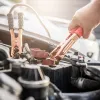
Repair Procedure with a Pulse Charger
At the same time, you must take care when using such a charger. The process requires attention and following precise steps for safety and efficiency.
Steps for Repairing the Battery
-
Initial check
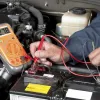
- Measure resting voltage (minimum 9V to have a chance of recovery)
- Visually inspect the battery for cracks or damage
- Check the electrolyte level in each cell
-
Preparation for repair
- Clean the terminals of corrosion
- Ensure the battery is in a ventilated area
- Wear protective equipment (gloves, goggles)
-
Connecting the charger
- Connect red clamps to the positive terminal
- Connect black clamps to the negative terminal
- Check polarity before starting
Operating Programs
Most pulse chargers have predefined operating programs. Like any device with pre-programmed routines, let it finish its sequence and then disconnect the unit.
Typical programs include:
- Desulfation mode — 2-8 hours for desulfation
- Slow charging — 12-24 hours for a full charge
- Maintenance — continuous monitoring and automatic corrections
- Final test — capacity check after repair
Testing the Results
Test the battery on the car after the process is finished. If possible, you can use the pulse charger directly on the car — there’s no need to remove the battery, but ensure the engine is off and the key is out of the ignition.
Indicators of Success
- Voltage should be above 12.4V at rest
- Starting capability — the engine starts without difficulty
- Voltage stability — it does not drop dramatically under load
- Charging time has improved compared to before
Precautions and Safety Tips
Working with batteries and chargers requires following safety measures:
- Do not smoke near the battery — risk of explosion
- Adequate ventilation — toxic gases can be released
- Protective equipment — acid-resistant gloves and goggles
- Check connections — loose connections can generate sparks
- Do not leave unattended — monitor the process periodically
When to Stop Repairing
Not all batteries can be saved. Stop repairing if:
- The battery is over 7 years old
- It shows cracks or physical deformations
- The voltage is below 8V after a repair attempt
- The electrolyte is turbid or abnormally colored
- The desulfation process shows no improvement after 24 hours
Preventive Maintenance
To avoid future battery deterioration:
- Regular charging — don’t let the battery discharge completely
- Keep it clean — remove corrosion from terminals monthly
- Periodic checks — test voltage every 3 months
- Temperature control — avoid extreme temperatures
- Regular use — cars that sit for long periods degrade batteries
Impulse chargers can be an effective solution to extend the life of car batteries, but success depends on the initial condition of the battery and proper procedures. However, repair cannot replace proper preventive maintenance.