When you own a car for an extended period, it’s almost inevitable to encounter various unusual problems and symptoms. It’s entirely normal because, over time, with wear and tear, car issues can arise. These problems can range from minor ones that you can fix yourself to major ones that require the expertise of professionals, and the costs can vary significantly.
That’s why in this article, we’ll be discussing a common issue in modern cars, specifically the engine shaking or trembling when an Volvo V50 is at idle. This is a topic not often covered, so we thought it would be useful to explore it and provide you with an idea of what might be causing your Volvo V50’s engine to shake when it’s idling.
What Parts Can Cause the Engine to Shake?
First, you should know that when your car’s engine shakes at idle, it’s relatively unlikely that the problem lies with the engine itself.
For example, if the engine isn’t getting enough air due to clogged filters, it may run and subsequently transmit vibrations throughout the entire car. So, if you feel that the engine isn’t running smoothly, the acceleration isn’t as responsive as it should be, and the engine seems to struggle or not run smoothly, you should start by checking the spark plugs, air filter, fuel filter, and the throttle body.
Engine mounts can also be a reason for the engine to shake only when it’s idling. The engine is mounted to the chassis with rubber mounts, which serve to secure it and absorb its movements. Due to the engine’s vibrations, these mounts can deteriorate over time. When they are no longer in good condition, they can’t effectively dampen the engine’s movements, leading to interior vibrations at idle.
Injectors can also cause the engine to shake at idle. If the injectors are not working in symmetry, for example, if cylinder 1 isn’t firing in sync with cylinder 4 and cylinder 2 with cylinder 3, the engine won’t run smoothly. If there are significant corrections needed for the injectors, the engine will shake not only at idle but also at higher RPMs.
In case you can’t perform the repair yourself, it’s advisable to take your car to a mechanic who can provide an accurate diagnosis of your car’s issue. However, most likely, the engine shaking in your Volvo V50 is caused by the previously mentioned components: spark plugs, air filter, fuel filter, engine mounts, or injectors. These should be the first things checked, possibly by a mechanic.

How Much Does it Cost to Replace Parts When Your Volvo V50’s Engine Shakes at Idle?
The cost of replacement depends on the part causing the issue. If it’s the fuel filter, which costs only a few tens of dollars, and the mechanic’s labor is around the same, you can expect to pay a maximum of $150 to replace the fuel filter and, of course, resolve the engine shaking issue.
If the issue is with the air filter, the cost of replacing this part should also not exceed $150, similar to the fuel filter.
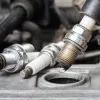
However, if the issue is caused by the spark plugs, the costs will be higher. Purchasing four spark plugs can cost up to $500-600, and the mechanic’s labor would be around $150-200. Therefore, replacing the spark plugs and resolving the shaking issue might cost around $1,000 at most.
Replacing engine mounts won’t cost much for the parts themselves, but the labor will be more expensive. You should budget around $500-600 for replacing all engine mounts.
Injectors will be the most costly. Reconditioning a single injector can cost between $250 and $450, but with labor included, the final cost could be around $2,000 for all of them.
Can I Continue Driving My Volvo V50 if the Engine Shakes at Idle?
Depending on the cause of the engine shaking, the answers vary. If the shaking is due to a clogged air filter or a clogged fuel filter, then yes, you can continue to drive for a short period until you replace one of these two parts.
However, if the issue is caused by faulty spark plugs or injectors, it’s recommended to replace these parts as soon as possible. Delaying these repairs can lead to more severe problems, including damage to the engine block this time.
Can I Repair the Car Myself?
As we’ve mentioned in other articles, it’s best to contact a mechanic to address your car’s issue. While you might be able to replace an air filter yourself, for example, when it comes to the fuel filter or spark plugs, things can get more complicated. Attempting to repair these on your own, especially if you lack expertise and are following tutorials from various websites, can potentially cause more significant problems to your car. So, in conclusion, regardless of your car problem, it’s advisable to seek out someone with knowledge and experience in mechanics rather than attempting DIY repairs, especially if you’re not well-versed in car maintenance.