- Dust particles from the environment enter the engine and pollute oil.
- Carbon deposits from combustion accumulate in oil, turning it into a paste.
- Oil degrades into an abrasive paste, causing premature wear if not replaced.
- Regular filter replacement prevents bypass and engine damage.
Oil filter is an essential component that is replaced together with the engine oil at every service. Many drivers wonder, however: if the engine runs in a closed circuit and the oil seems clean, where does the dirt that ends up in the filter come from? The answer reveals the complexity of the processes that occur inside the engine.
Main sources of dirt in the car engine
Dust particles from the external environment
Contrary to common perception, the engine is not completely isolated from the outside environment. In each operating cycle, the engine draws in atmospheric air that reaches the combustion chambers. Although the air passes through the air filter, extremely fine dust particles manage to enter the system. These microscopic particles are then picked up by the engine oil during its circulation through all engine components.
Carbon deposits resulting from combustion
The combustion process is never perfect. The oil filter must also cope with carbon deposits that form as a result of burning the fuel–air mixture. These carbonaceous residues are inevitable and accumulate gradually in the engine oil, turning it from a clean lubricant into a suspension with solid particles.

Process of engine oil degradation
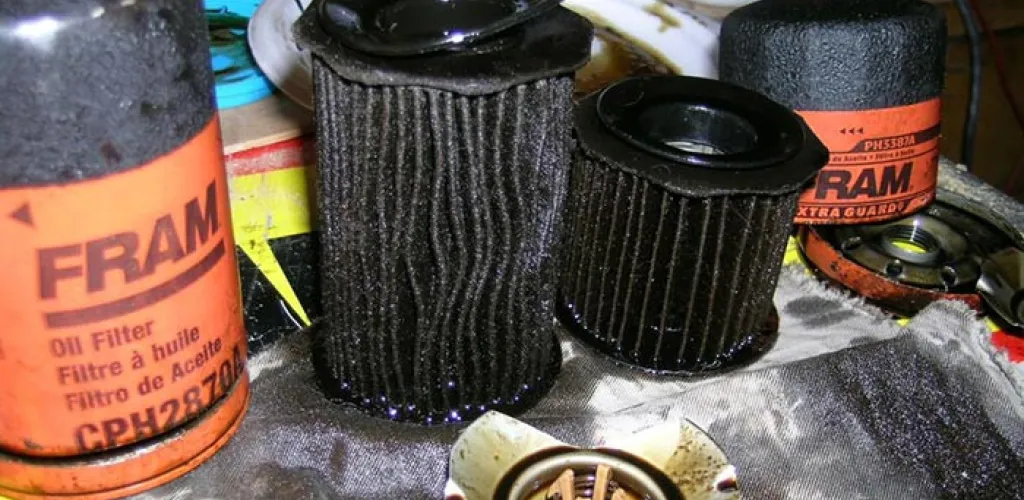
As time passes and kilometers accumulate, engine oil gathers more and more impurities. The combination of dust particles and carbon deposits gradually turns the oil into an abrasive paste. This “paste” acts as a fine abrasive that can cause premature wear of metal components inside the engine.
Effects of premature wear
Tiny metal particles resulting from friction are then carried by the circulating oil, amplifying the degradation process. An engine left running with the same oil for extremely long periods (100,000 km) can turn the oil into a gel-like substance, incapable of lubricating and protecting.
The oil filter’s critical role
For these reasons, the oil filter becomes a vital element in maintaining the health of the engine. Its role is to stop all these harmful particles before they reach the moving surfaces of the engine — pistons, rings, bearings, crankshaft, and other critical components.
What happens when the filter becomes clogged
By-pass system – an emergency solution
When the oil filter is filled with impurities and can no longer function effectively, a protection mechanism called the bypass system kicks in. This system allows the oil to bypass the clogged filter and reach the engine directly, but in this case the oil is no longer filtered.
Consequences of bypass operation
Although the bypass system prevents engine seizure from lack of oil, prolonged operation in this mode can cause:
- Accelerated wear of engine components
- Additional deposits in oil passages
- Reduced lubrication efficiency
- Increased risk of major failures
Importance of regular oil filter replacement
To avoid all these problems, it is essential not to neglect replacing the oil filter. It must be replaced whenever you change the engine oil, following the manufacturer’s recommended intervals.
A new oil filter guarantees:
- Optimal filtration of impurities
- Protection of engine components
- Maintaining oil properties longer
- Efficient operation of the lubrication system
Failing to observe these intervals can lead to costly failures that far exceed the cost of a simple oil and filter service.